


New technologies applied to healthcare architecture (Part II)
In this second part of our post, we will continue to clarify the key points about the impact of technological advances and AI on healthcare architecture. We have summarised the most important points that clarify the subject, based on the presentation by Francisco Ortega, Director of ENERO Arquitectura, at the EuHPN Workshop 2024.
New technologies in facility management
With the integration of AI, facility management in the architectural context will rapidly evolve towards predictive maintenance. The management of buildings will begin long before they are built. So-called smart buildings will be able to determine their own energy consumption at the design stage. In addition, these buildings will integrate sensory devices, modules for data processing and use algorithms for optimisation as well as control systems. One of the major developments will be in the area of optimising energy consumption. Predictive consumption will be based on weather, occupancy, etc. All the data collected in real time will significantly improve the control of air conditioning systems, lighting and the integration of renewable energies, based on real needs at any given time.
On the other hand, robotics will also increasingly accompany facility management. We will find robots integrating AI as medication dispensers in healthcare settings and also as storage management aids. They will also be more present in patient monitoring and cognitive support. In entertainment and autonomous disinfection processes, the contribution of AI in robotics will also see major developments in the near future.
Conclusions: What is the perspective from an architectural point of view?
The impact of new technologies will increase flexibility in buildings. Such flexibility will not be based on adaptability as the expression is now understood in the current architectural debate but will define multifunctional spaces in healthcare environments. What are these spaces based on? Modular design will prevail to ensure adaptive proposals, standardised rooms and expandable structures. In addition, patient-centred architectural design will be definitively established. In healthcare architecture, it will be essential to make infrastructure provisions for future technologies comprised of large digital and electrical equipment.
The rooms will integrate increasingly sophisticated technologies and will be equipped with everything necessary for patient care. The trend will be to minimise the movement of patients within healthcare spaces. During their different stages of care, patients will be attended to in smart rooms. Tests, check-ups, stays and even interventions will be carried out in this single space with the most advanced technology, minimising patient journeys within the healthcare centre and facilitating exhaustive monitoring. The design of these rooms will be even more relevant to the architectural project as a whole. The integration of technologies in smart rooms will significantly improve the patient experience in hospital, enhancing their comfort and increasing the efficiency of clinical processes. Flexible and decentralised workstations will be necessary to ensure workflow optimisation for healthcare workers.
The dimensions of specialised equipment will grow exponentially, as is the case for equipment in proton therapy centres, with the need for large spaces for the proton generator or the new magnetic resonance equipment, which is 30 times heavier than the current equipment.
How will technology be integrated into the various spaces within healthcare centres? In operating theatres, it will be necessary to concentrate all the technology: screens, anaesthesia towers, etc., in a small space.
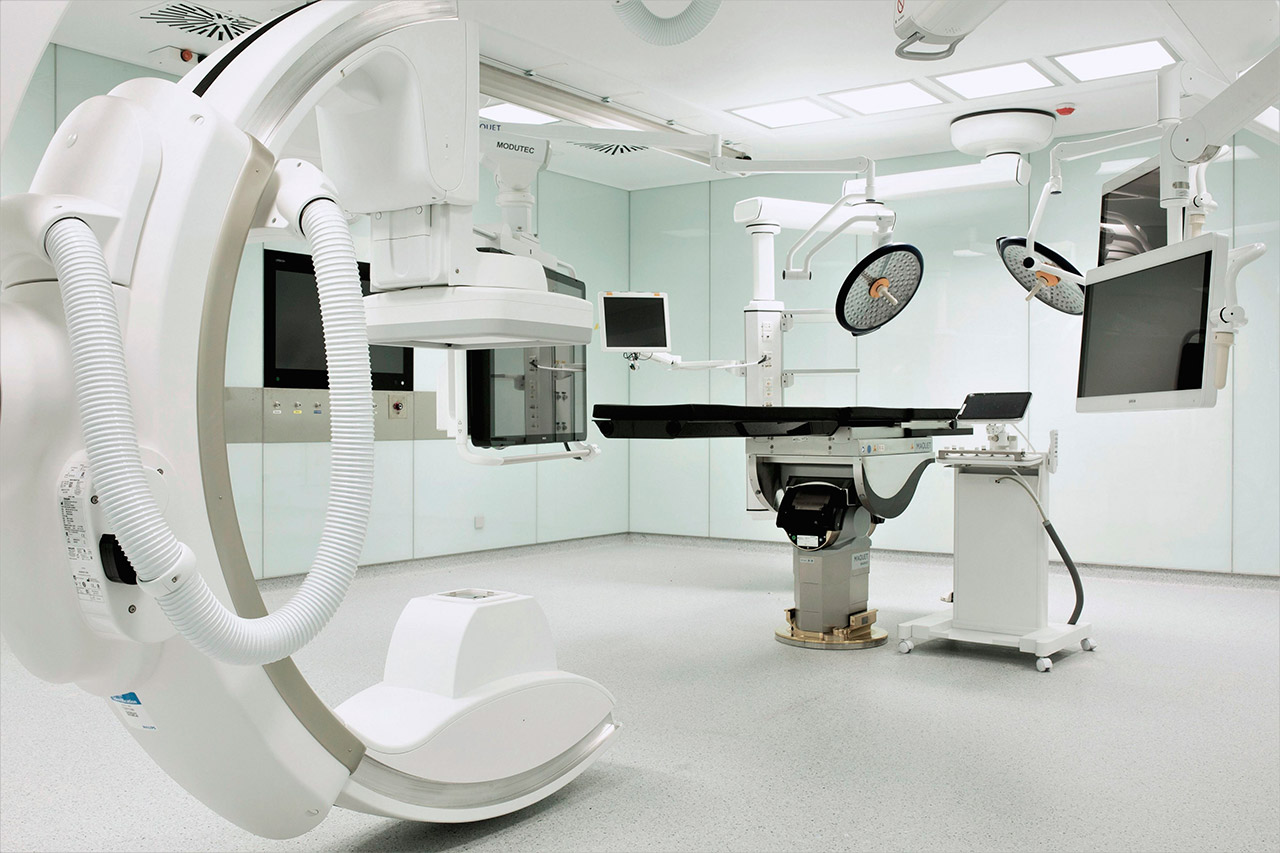
Telemedicine will also require the design of new spaces within healthcare centres, such as connectivity rooms and telemedicine platforms (with audiovisual systems, etc.). The integration of sensors and new areas for robot storage, data centres, etc. will also be taken into account in the architectural design.
We will see increasing personalisation of patient areas. AI makes it possible to recognise the patient’s behaviour and adapt the space to their needs.
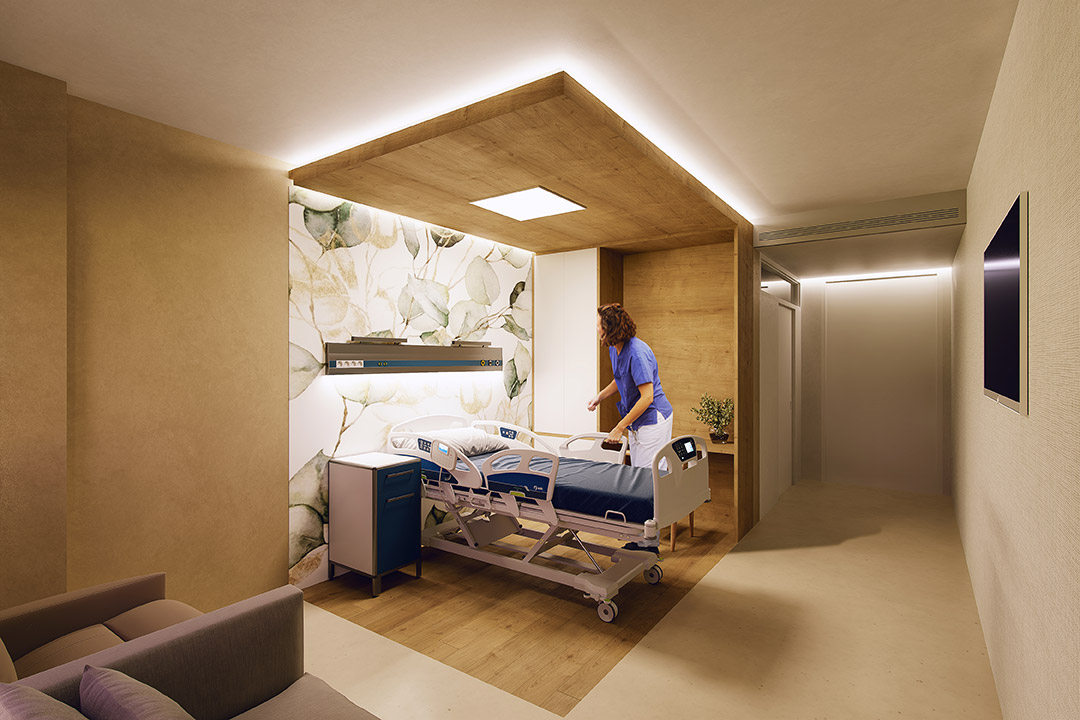
The virtualisation of the patient experience will force a delocalisation of spaces for patient-healthcare worker interaction.
The healthcare centre of the future will be a high-tech smart building with advanced machines and minimal but comfortable spaces for patients.