


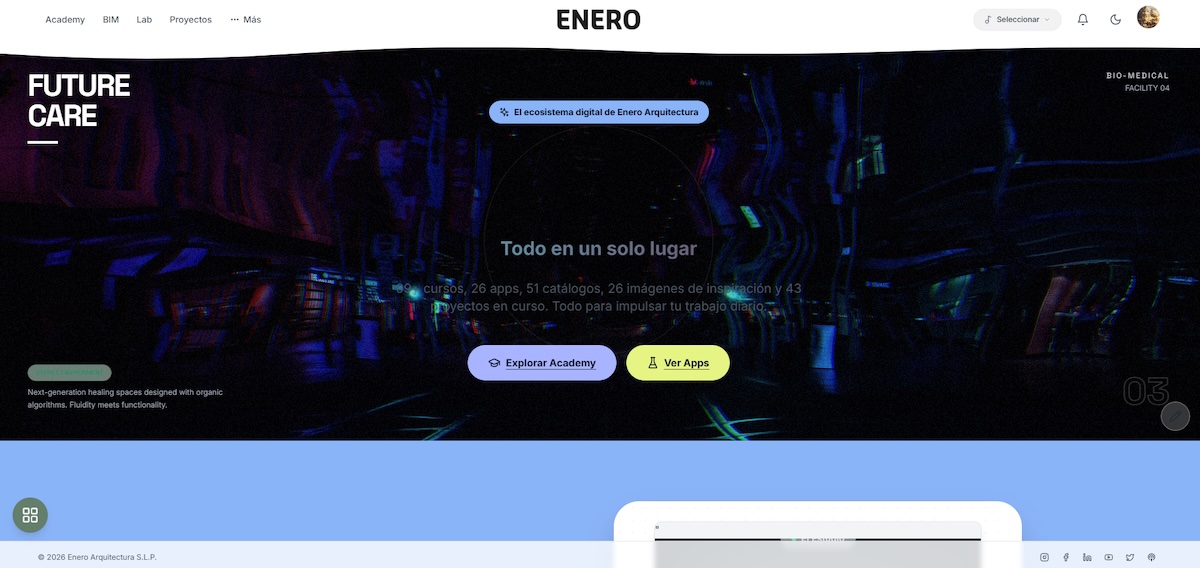
ENERO HUB: AN ECOSYSTEM TO TRANSFORM ARCHITECTURE
At ENERO Arquitectura, we have spent years reflecting on how to improve the way we work. Our specialization across different areas of architecture demands precision, constant updating, and a huge capacity for coordination between teams. For this reason, we developed ENERO Hub, an internal and external knowledge platform that allows us to share information, organize processes, and strengthen our identity as a specialized practice.
In this blog entry, we speak with Jacinto Morós, Director of Innovation, to take a closer look at how this ecosystem works. His vision is clear: technology does not replace architectural judgment, it supports it. As he himself says, “innovation only makes sense if it is at the service of the project and of the people who develop it.” That idea neatly sums up the spirit of ENERO Hub.
Out of a hybrid working context, where part of the team is in the office and part works remotely, a shared space emerged that connects knowledge, talent, and processes. Today, ENERO Hub is that shared place.
TRAINING, TALENT, AND SHARED KNOWLEDGE
One of the fundamental pillars of the Hub is ENERO Academy. It is the firm’s continuous training space. Here we organize internal courses, share useful videos, and generate specific content that allows us to stay up to date in healthcare regulations, hospital design, and working methodologies.
The Academy is the most widely used environment. This shows that, before any tool, what remains most valuable is collective learning. Architecture requires constant updating, and for that reason we need the entire team to share the same knowledge base.
ENERO Hub includes an internal library where individual knowledge becomes collective heritage. Construction details, standard solutions, regulatory references, and site experience are documented and accessible to everyone. In this way, we avoid the dispersion of information and reinforce our specialization.
In the “Talent” area, we compile the team’s professional profiles, including comments on specialties and experience. This allows us to quickly identify who can bring the greatest value to each project. This internal visibility is key in order to adapt teams and rely on specialists in functional planning, medical technology, or construction in occupied environments.
The “Business” environment integrates the management of hours, clients, projects, and roadmaps. Each project has a specific workflow associated with it, along with dedicated tools that help us maintain order and traceability. In addition, we have spaces such as “Resources,” where we manage software and licenses, as well as desk booking systems and a shared calendar, all of which are essential in our hybrid model.

SPECIALIZATION, CONSTRUCTION, AND EXTERNAL PROJECTION
The architectural diagram generator has become a particularly valuable tool. It helps us structure complex functional programs, organize relationships between critical areas, and visualize flows of patients, staff, and supplies from very early stages.
These kinds of internal developments strengthen our capacity to take on competitions and commissions with speed and consistency. This active memory allows us to analyze strategies, review proposals, and learn from each experience.
We are also working on tools linked to the construction phase. The goal is for the digital model to accompany the building process and facilitate the monitoring of decisions, changes, and approvals.
Our intention is to share these advances in specialized forums and sector meetings related to project management and innovation in healthcare construction. We believe that dialogue with other stakeholders in the sector is essential in order to continue growing.
ENERO Hub is not just an internal platform. It is a way of understanding the firm as a connected organism, where training, methodology, and specialization reinforce one another. In an increasingly complex context, we need solid structures to support our professional practice.
BIM, ISO 19650, AND A RESPONSIBLE WAY OF MANAGING INFORMATION
One of the most important sections of ENERO Hub is the BIM area. Here we can find specific plug-ins created expressly for the activity of ENERO Arquitectura.
This commitment to BIM is part of the way we understand architecture. We do not see it as an isolated tool, but as a methodology that organizes, connects, and gives coherence to the entire design process.
This year, we renewed our ISO 19650 certification, the international standard governing information management in collaborative environments. For us, it is not just a badge. It is confirmation that our way of working responds to demanding, measurable, and shared criteria.
In day-to-day practice, this translates into something very concrete: architects, engineers, consultants, and contractors all work from a common base. Information has a defined structure, documents follow consistent criteria, and every piece of data has an owner. When everyone shares the same framework, noise disappears and decisions are made more clearly.
This is especially relevant in the different projects we carry out. The functional complexity of a hospital requires extreme coordination between disciplines. Detecting conflicts in the model before they reach the construction site means protecting deadlines, budgets, and above all the future quality of care.
Another fundamental aspect is information traceability. We make sure that every decision is backed by verified and updated information. This reinforces the solidity of the project from the earliest conceptual phases through to execution.
We also pay special attention to security. Working within the ISO 19650 framework means applying strict control and confidentiality protocols. The information of our clients and collaborators is managed responsibly and respectfully. In an increasingly complex digital environment, this guarantee is essential.
